

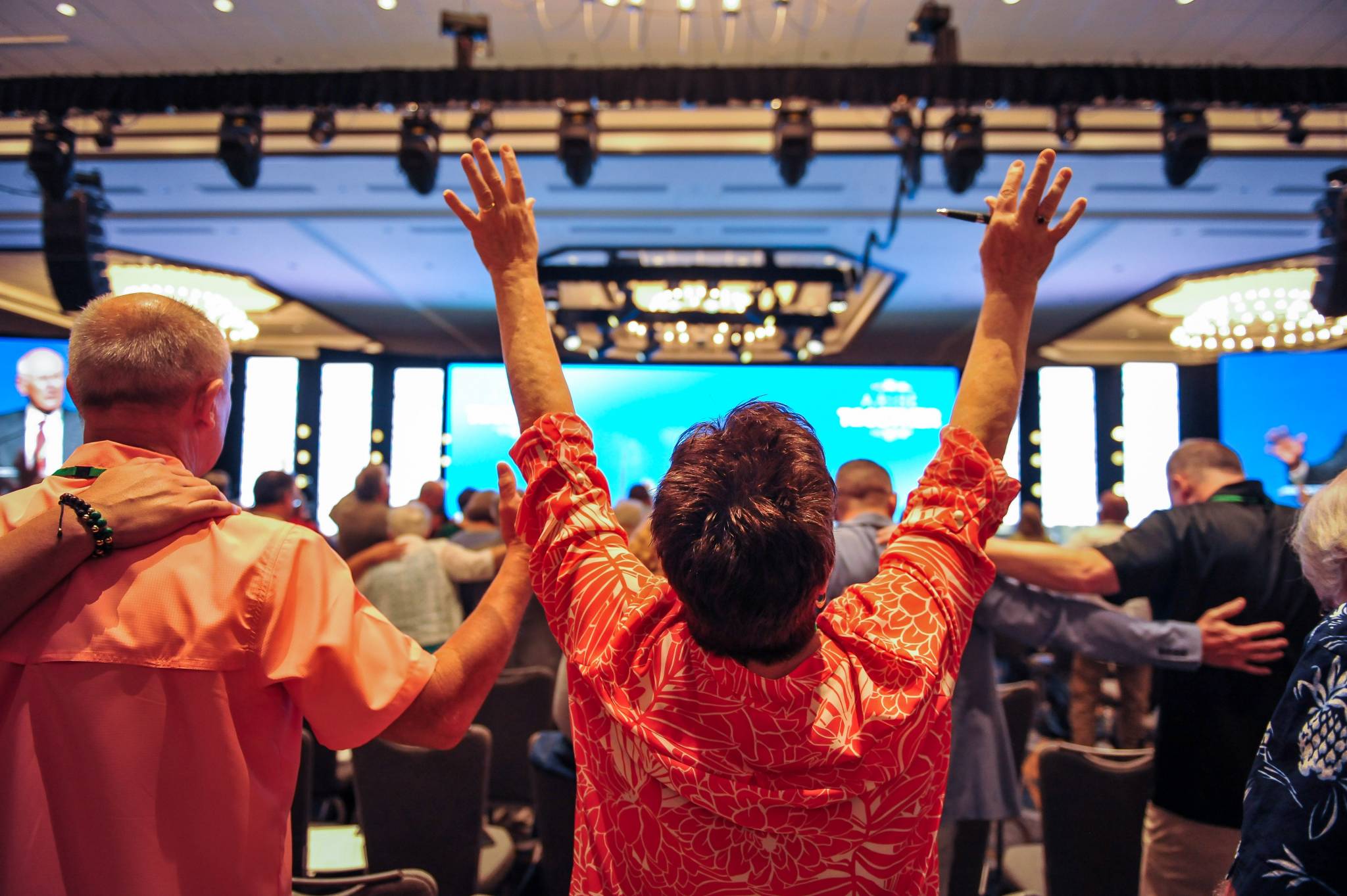
NCIPHC Heritage Lectures | October 18, 2025
Jonathan Altman serves as the Lead Pastor of Saint Paul Church in Greenville, NC, and as the Assistant Conference Superintendent of the North Carolina Conference of the International Pentecostal Holiness Church. He’s a graduate of Campbell University (B.B.A. and M.Div.), Gordon-Conwell Theological Seminary (Th.M.), and Fuller Theological Seminary (D.Min.). His partner in ministry is his wife, Anna, who’s also an ordained minister in the IPHC. Together, they have two children.
When Archives Director Ricky Nelms and I were discussing today’s lectures, we both expressed a desire for them to address the past as well as the present. In other words, we did not want them only to be historical, but also to address ministry today. So, we came up with the title “How Can a Classical Pentecostal Church Reach a Contemporary World? Lessons from the
Past.” In our minds, that would hopefully help people appreciate in a greater way what God has
done in the past and what He can do in our time, too.
When I began my research, I assumed I would ultimately provide a list of historical lessons, such as the need to prioritize prayer, give the Holy Spirit freedom in services, and embrace people across racial and economic lines. However, as I continued to read and reflect, one truth seemed to undergird all the others: our predecessors were captivated by the gospel. That is to say, the gospel motivated their lives and ministries.
You may ask who these predecessors are and what I mean when I refer to “the gospel.” In short, these individuals include members of the Fire-Baptized Holiness Church and the Pentecostal Holiness Church until 1930. That is not to suggest that people after 1930 did not value the gospel; I am certain they did. It is simply that when I got to that place on the timeline, I thought, “I have more than enough to work with. I should place a boundary marker here.”
Now, what about the gospel? What do I mean when I say they were “captivated by the
gospel”? I’m referring to what is often called the “five cardinal doctrines”—the belief that Christ is Savior, Sanctifier, Baptizer in the Holy Spirit, Healer, and Soon-Coming King. Of course, this fivefold understanding developed over time, particularly in relation to the baptism in the Holy Spirit. However, as I mentioned a moment ago, this constituted the heart of what our predecessors believed.
I recognize this is not a groundbreaking assertion, but it deserves our attention. One may wonder if we, their spiritual ancestors, are also captivated by the gospel. One may ask if our lives and ministries are built on this foundation. I do not want you to take my word for it, though. I
want you to see this for yourself, as well as how our predecessors’ convictions can offer us
guidance today.
The Fivefold Gospel
Let us start by turning our attention to Christ’s role as Savior. This was the cornerstone of our forebears’ beliefs. It provided a foundation for everything they believed about the gospel of Jesus Christ.
Christ the Savior
Justification by faith was a founding doctrine in both the Fire-Baptized Holiness Church and the Holiness Church of North Carolina (later known as the Pentecostal Holiness Church).1 It was a foundational conviction after the groups merged in 1911, too. Together, they affirmed, “We believe, teach and firmly maintain the Scriptural doctrine of justification by faith alone (Rom. 5:1).”2 (If that sounds familiar, it should—it is still part of our Articles of Faith.)
As Presiding Bishop A. D. Beacham, Jr. has noted, this statement reflects the influence of Protestant Reformer Martin Luther and the Augsburg Confession of 1530.3 It was not merely a historical reference, though. It was a core conviction of our predecessors. Consider how the 1897 edition of The Discipline of the Holiness Church expressed it:
Having repented scripturally, we are then able to exercise faith in Christ Jesus as our personal Savior, which brings pardon and the “new birth” or regeneration to the trusting soul.
In consequence of this two-fold change from guilt to innocency and from death to life, we are “new creatures” in Christ, having righteousness and peace and joy in the Holy Ghost. This is real conversion and includes justification and regeneration.4
Note the last line: repentance and faith constitute “real conversion,” or real transformation. This means a person is declared righteous in God’s heavenly courtroom and born again by the Spirit by faith.
One might think that our spiritual ancestors might have touched lightly on this doctrine to get on to more “heartwarming” and “explosive” tenets of the faith, such as sanctification and Spirit baptism. As we see here, however, they believed justification by faith deserved a thorough explanation. Additionally, they believed they needed to share this good news with the world.
One place this comes into focus is in a brief article on a missions organization called the World-Wide Mission Band in a 1909 issue of The Apostolic Evangel. There, editor J. H. King, who led the Fire-Baptized Holiness Church and who would later lead the Pentecostal Holiness Church, wrote:
We all cannot go [to be missionaries], but can pray and we must pray, pray with all
prayer for God’s world-wide purpose to be fulfilled in the world’s redemption. We can give and we must give or lose far more by not giving. If we can go we must go or go into darkness and finally into eternal misery. God help us. We need and must have a love,
prayer, liberality and consecration planet wide. God’s love is planet wide, the atonement
1 A. D. Beacham, Jr., Remembering for the Future: A Commentary on the IPHC Centennial Covenant
(International Pentecostal Holiness Church: 2020), 24.
2 Constitution and General Rules of the Pentecostal Holiness Church, 1911, 3.
3 Beacham, 17-18.
4 The Discipline of the Holiness Church (Louisville, KY: Pentecostal Herald Press, 1897), 8. is planet wide and the commission of Jesus is planet wide, and if we get all these in us we will be planet wide Christians.5
In other words, King said Christ is Savior, and the world must hear this news. It is worth noting that King wrote this just before his worldwide missions tour, which required him to miss the merger of the Fire-Baptized Holiness Church and the Pentecostal Holiness Church.6 He demonstrated in both word and deed that the gospel captivated him.
Christ the Sanctifier
The Fire-Baptized Holiness Church and the Holiness Church of North Carolina also affirmed Christ’s role as Sanctifier in their founding doctrines.7 After they united, they expressed their convictions by stating, “We believe also that entire sanctification is an instantaneous, definite, second work of grace obtainable by faith on the part of the fully justified believer (John 15:2; Acts 26:18).”8 Both groups were forged in the fire of the Holiness movement and unequivocally affirmed that Jesus can, in an instant, completely sanctify those who have faith.
This was a powerful motivation for our predecessors’ ministries. A. B. Crumpler, for example, who started the Pentecostal Holiness Church, wrote in 1904 that the mission of the
organization was to “‘spread scriptural holiness over these lands’ and to carry the gospel of full salvation.”9 J. H. King, on the other hand, left Methodism, which he dearly loved and in which he had pastored, so he could preach holiness without hindrance.10 Perhaps one of the most
poignant examples of sacrifices for sanctification comes from F. M. Britton, a Methodist minister turned Fire-Baptized Holiness minister who helped lead the merger with the Pentecostal Holiness Church. He wrote:
I well remember walking until my socks were wet around my toes with blood from ingrowing toenails. I walked twenty-four miles and preached three times on Sunday a many a time to get holiness established in S.C. Well I do remember walking 75 miles to hold a meeting in a new field where poor people were begging me to go, and after the meeting was over and many were saved and sanctified, I rode a short distance so the people would not know but what I rode all the way home. But when I remembered my wife and children at home . . . I got off the train and walked over 60 miles so I could have something to live on while I was holding another meeting……………………………………………………………………………………… ”11
Our predecessors were captivated by the gospel. They knew Christ as Sanctifier for themselves, and they were compelled to help others know him too by preaching, teaching, evangelizing, and
5 J. H. King, “World-Wide Mission Band,” The Apostolic Evangel, June 1, 1909, 5.
6 Vinson Synan, Old Time Power: A Centennial History of the International Pentecostal Holiness Church
(Franklin Springs, GA: LifeSprings Resources, 1998), 120-21.
7 Beacham, 24.
8 Constitution and General Rules of the Pentecostal Holiness Church, 1911, 3.
9 A. B. Crumpler, “The Holiness Church,” The Holiness Advocate, July 15, 1904, 4.
10 Synan, 58.
11 F. M. Britton, Pentecostal Truth, or Sermons on Regeneration, Sanctification, the Baptism of the Holy Spirit, Divine Healing, the Second Coming of Jesus, etc. (Royston, GA: Publishing House of the Pentecostal Holiness Church, 1919), 224-25, 232-41. writing. B. H. Irwin, for example, who founded the Fire-Baptized Holiness Church, drank deeply from the wells of Holiness publications, and eventually purchased a press so he could publish his own periodical, Live Coals of Fire, to spread the message.12
Christ the Baptizer in the Holy Spirit
Irwin’s most enduring legacy was his laying the foundation for our forebears’ understanding of Christ as Baptizer in the Holy Spirit. He did this by teaching that the baptism of the Holy Ghost and fire comes after salvation.13 It was not until after the Azusa Street Revival, however, that our predecessors began to affirm the doctrine as we know it today. Following the merger of the Fire-Baptized Holiness Church and the Pentecostal Holiness Church, the newly united group expressed it this way: “We believe also that the Pentecostal baptism of the Holy Ghost and fire is obtainable by a definite act of appropriate faith on the part of the fully cleansed believer, and that the initial evidence of the reception of this experience is speaking with other tongues as the Spirit gives utterance (Luke 11:13; Acts 1:5; 2:1-4; 8:17; 10:44-46; 19:6).”14
- F. Taylor, who later started the Franklin Springs Institute, now known as Emmanuel University, was an early advocate of this doctrine.15 In 1907, he published a book entitled The Spirit and the Bride, in which he advanced and defended his conviction. The final portion of the book provides practical instruction on “how to obtain and retain the baptism of the Holy Ghost,” with Taylor claiming his publication would not be complete without it.16
One person who received this baptism in the early days was Katie Parker from Mount Olive, NC. She was saved under G. B. Cashwell and sanctified and filled with the Holy Spirit under J. H. Sutton and A. H. Butler. In a 1907 issue of The Holiness Advocate, she wrote:
It seemed that my heart would break. I said, Lord, you know my heart, and if the temple is not in order to receive the Holy Ghost, do, for Jesus’, sake, [sic] prepare it. I had not more than finished my little prayer before the Lord sanctified my soul. I kept holding on until two days later the blessed Holy Ghost came in His temple and manifested himself with my tongue, and ever since that day there has been a river of love, joy and peace in my soul every day and hour. Praise His blessed name. It never runs dry.17
- B. Crumpler was a prominent person who did not affirm this doctrine. His point of concern was tongues as initial evidence. This led to his departure from the Pentecostal Holiness Church in 1908 and his return to the Methodist church. Historians say he spent the rest of his life as a layman, lawyer, and supply pastor.18 Despite this, the Pentecostal Holiness Church forged ahead, captivated by the gospel.
12 Synan, 45, 53.
13 Ibid., 61.
14 Constitution and General Rules of the Pentecostal Holiness Church, 1911, 3.
15 Synan, 56-57.
16 G. F. Taylor, The Spirit and the Bride (Dunn, NC: Private Printing, 1907), 131.
17 Katie Parker, The Holiness Advocate, June 15, 1907, 6.
18 Daniel Rollins, Forward, Ever Forward: A History of the North Carolina Conference of the Pentecostal Holiness Church (Franklin Springs, GA: LifeSprings Resources, 2011), 87-90.
Christ the Healer
Divine healing was another foundational doctrine in both the Fire-Baptized Holiness Church and the Holiness Church of North Carolina.19 After the 1911 merger, the Pentecostal Holiness Church affirmed, “We believe in divine healing as in the atonement (Isa. 53:4, 5; Matt. 8:16, 17; Mark 16:4-8; James 5:14-16; Ex. 15:26).”20 By grounding the doctrine of divine healing in Christ’s atoning work, our predecessors identified sin as the source of sickness. However, they believed healing was possible because Christ dealt decisively with the problem of sin through His death and subsequent resurrection.21
In 1920, different convictions on divine healing led to controversy. While one group believed it was permissible for Christians to use medicine, others sharply disagreed, insisting that people should trust God for their healing. In 1921, this led the “pro-remedy” group, composed mainly of believers in Georgia, to leave the Pentecostal Holiness Church and establish the Congregational Holiness Church.22 The Pentecostal Holiness Church later admitted its misstep, recognizing that God also provides healing through medicine.23
One example of our predecessors’ belief in divine healing is found in the life of A. H. Butler. In 1917, he wrote a letter to The Pentecostal Holiness Advocate, providing an update on his recent ministry activities as Superintendent of the North Carolina Conference. He wrote that, after preaching to “a right large congregation of tired and sleepy farmers” at Hodge’s Chapel in Chocowinity, NC, he went home with J. M. McRoy, where he heard a mule groaning. Noticing that the mule was sick, Butler and McRoy prayed for the mule, with Butler testifying, “She got well in a few minutes, and pulled me to the depot the next morning. Glory. He can heal all manner of sickness and everything that gets sick or afflicted.”24
This may seem trivial or even humorous, but it indicates a profound belief in God’s power and care for His creation. In the early 1900s, many people in Eastern North Carolina depended on mules for farming and transportation. When the health of McRoy’s mule was in jeopardy, he and Butler did not fret; they turned to the One they knew could help: Christ the Healer.
Christ the Soon-Coming King
The final aspect of our predecessors’ fivefold gospel is the belief in Christ the Soon-Coming King. This was a founding doctrine in both the Fire-Baptized Holiness Church and the Holiness Church of North Carolina.25 After the 1911 merger, our forebears expressed their conviction by stating, “We believe in the imminent, personal, premillennial second coming of
19 Beacham, 24.
20 Constitution and General Rules of the Pentecostal Holiness Church, 1911, 3.
21 Beacham, 25.
22 Synan, 162-67.
23 Beacham, 51-52n25.
24 A. H. Butler, The Pentecostal Holiness Advocate, May 17, 1917, 14-15.
25 Beacham, 24.
our Lord Jesus Christ (1 Thess. 4:15-18; Titus 2:13; 2 Peter 3:1-4; Matt. 24:29-44), and we love and wait for His appearing (2 Tim. 4:8).”26
As Presiding Bishop Beacham has noted, several nineteenth-century streams of thought influenced this statement, including: (1) the belief that the Holy Spirit’s outpouring indicates that Christ will soon return; (2) premillennialism, which teaches that Christ will return before the millennial reign of Revelation 20; (3) a pretribulational view of Christ’s return, meaning He will rapture His people before the tribulation of Matthew 20; (4) dispensationalism, which divides human history into distinct periods, or dispensations; and (5) the belief that Israel plays a unique role in biblical prophecy.27
- F. Taylor wrote at length on this doctrine in his book The Second Coming of Jesus.
After expressing dissatisfaction with other positions on Christ’s return, Taylor wrote: “At the
head of this chapter we have the simple statement, ‘The Son of Man cometh’ [Matt. 24:44]. If we had no other Scripture, we should expect the Son of Man to come. One jot or one tittle of God’s Word is as sure as God Himself. It can never fail.”28
Taylor was convinced of Christ’s return, and he wanted others to believe it too. He explained, “The wicked will grow worse until Jesus comes; the righteous, at least a part of them, will grow better. Some day, without any warning, the trump of God will sound, Jesus will pass around the world as lightning, and those who are alive and are ready for His coming, with all who died ready for His coming, will be caught up to meet the Lord in the air.”29 Taylor longed for both he and his readers to one day live in the Holy City, the New Jerusalem.30
In his history of the North Carolina Conference, Daniel Rollins summarizes the ministries of A. H. Butler and G. F. Taylor with the following description: “Together, they gave voice to a small sectarian group of believers, convinced that the same Jesus who saved them and healed them and filled them with the Holy Ghost would soon come back to take them to Heaven.”31 In short, they were captivated by the gospel, as were our predecessors at large. It motivated their lives and ministries, galvanizing them to reach the world.
Moving Forward
We do not simply want to look at the past, however. We also want to talk about what God can do today. We want to consider how a classical Pentecostal church can reach a contemporary world. Considering what we have covered so far, I would like to offer three suggestions to you.
Identify What Captivates You
The first is to identify what captivates you. In other words, identify what occupies your
26 Constitution and General Rules of the Pentecostal Holiness Church, 1911, 4.
27 Beacham, 26.
28 G. F. Taylor, The Second Coming of Jesus (Falcon, NC: Falcon Publishing Co., 1916), 2.
29 Ibid., 4.
30 Ibid., 264.
31 Rollins, 99.
mind; identify what enthralls you and motivates your life and ministry. Is it the fivefold gospel, as was the case with our spiritual ancestors? Or is it something else? It could be money. It could be applause. It could be the next vacation. Ask yourself what captivates you.
One thing I have noticed in my life, as well as in the lives of others, is that people are often captivated by the gospel when they first encounter God. When they are first saved or baptized in the Holy Spirit, they cannot help but tell others about it. Over time, however, that fervor can fade, and their walk with God can become, for a lack of a better word, routine. They can find themselves just going through the motions.
I think of what it is like when you go out in the ocean. You can feel like you are in the same spot; you can feel like you are in the same place. But when you look back to shore, you see that you have drifted. The current has moved you without you realizing it.
Has that happened to you? Is that the case with your life? Are you still captivated by the gospel? Do you still have the same passion to reach people for Jesus that you once did? If not, what energizes you? What gets you out of bed each morning? What keeps you in the fight?
As I mentioned a moment ago, it could be several things. If you’re a pastor, it could be church growth. Do you dream of higher attendance and a bigger budget? Or are you simply trying to keep your church alive? I want you to know that God has something better for you; He has something grander for you. He wants you to be captivated by the gospel. He wants you amazed by the good news that Christ is Savior, Sanctifier, Baptizer in the Spirit, Healer, and Soon-Coming King!
I say this not out of condemnation. God knows lesser things have captivated me at times.
Instead, I say this because our hearts can drift away from the things of God. In the words of Revelation 2:4, we can abandon the love we had at first. We can get so caught up in ministry and doing things for God, that we miss out on God Himself. Truth be told, when I read about our predecessors, I often feel convicted. I see that they were willing to do whatever it took to spread the gospel, and yet I am often tempted to resist discomfort.
So, identify what captivates you. Identify what enthralls you. If it is anything other than the Lord and the good news of Jesus Christ, it is not enough and will not enable you to live fully into God’s good plans for you.
Ask God to Captivate You with the Gospel
That leads me to my next suggestion: Ask God to captivate you with the gospel. After you have identified what captivates you, ask God to captivate you with the gospel. And if you are already captivated by the gospel, ask God to captivate you in an even greater way!
Note that I did not say, “Captivate yourself with the gospel.” By stating that we should ask God to captivate us, I am making clear that we need God to work in our lives. This is not about trying harder or doing more. This is about allowing the Lord to do what only He can do.
One verse that comes to mind in this regard is the first part of Psalm 51:12. There, David cries out, “Restore to me the joy of your salvation” (NIV throughout). According to tradition, this psalm was written after Nathan confronted David about committing adultery with Bathsheba. You are likely familiar with that story. It is found in 2 Samuel 11 and 12.
One night, while David was standing on the roof of his palace, he saw Bathsheba bathing on her roof. He sent for her, slept with her, and upon finding out she was pregnant, he brought her husband, Uriah the Hittite, back home from war to cover it up. He hoped they would be intimate together and Uriah would think the child was his. Uriah the Hittite, however, had too much honor to sleep with his wife while his fellow soldiers were on the battlefield, so David sent him to the front line and ordered that the other soldiers withdraw from him so he would die, and that he did.
After this took place, Nathan the prophet confronted David. He delivered a word of judgment from the Lord. Nathan said out of David’s own household the Lord would bring calamity upon him, and that the son Bathsheba was pregnant with would die. As a result of this, tradition says David wrote Psalm 51. In it, he pleads for the Lord to have mercy on him and to cleanse him of his sins. Then, in verse 12, he says, “Restore to me the joy of your salvation and grant me a willing spirit to sustain me.” What does that mean? It means he wants to know the joy of the Lord’s deliverance. He longs to rejoice because the Lord has saved him.
You and I may not be in David’s position, but I cannot help but wonder how amazing it would be to experience the joy of salvation again, to know the thrill of experiencing God’s deliverance, to know the lightness, to know the enthusiasm, to know the energy that we experienced when we first got saved. Ask God to restore it to you. Ask God to make it real to you. Ask God to move your heart so you can know in a fresh way how good the good news of Jesus really is.
To go back to Revelation 2:4, which I mentioned earlier, ask God to help you return to the love you had at first. Ask Him to fade everything else into the background and to captivate you with His goodness and His love. That is what the gospel is, by the way: an expression of His goodness and love. Remember, Jesus is God’s greatest gift. He is God’s supreme act of love. Ask God to awaken your heart and captivate you with the gospel!
I must ask the Lord to do this every so often. I am not simply talking about taking a day off or enjoying some vacation time. I am talking about asking God for an encounter with Him, asking Him to move in my life, asking Him to clear away all the busyness and all the distractions and to rekindle my love for Him. I suspect that all of us need to do that from time to time. It is like a bonfire. At first, it may burn brightly and strongly, but if you do not keep adding fuel to it, it will go out. All you will be left with is ashes. We all need fuel for our fire!
This is one reason my church designates 21 days for prayer and fasting each January. I know the IPHC does this at the general level, but I make a concerted effort to encourage our people to seek the Lord during this period as a family of believers. We ask God to captivate us. We ask God to awaken us. We ask God to remove everything in our lives that is not of Him, and to help us know Him in a greater way.
Ask God to captivate you with the gospel. Ask God to captivate you with the good news. Ask God to captivate you with the truth that Jesus is your Savior, your Sanctifier, your Baptizer in the Holy Spirit, your Healer, your Soon-Coming King.
Let that Captivation Motivate You
That leads me to my third suggestion. After you have identified what captivates you, and after you have asked God to captivate you with the gospel—let that captivation motivate you. Let it propel your life. Let it ignite your ministry. Let it send you out to tell others about it so they can know it for themselves.
I personally believe Christians’ not being captivated by the gospel is the underlying issue of many of their problems. Spotty church attendance? Failure to give? Refusing to serve? In many cases, the underlying issue is that the gospel has not captivated them. So, when I say we should let our gospel captivation motivate us, I mean we should let it motivate us so others might be captivated and motivated too.
Since the topic of today’s lectures is about classical Pentecostal churches reaching a contemporary world, let me talk for a bit about church ministry. To get to the point, we cannot expect our people to be captivated by the fivefold gospel if we do not preach and teach on it and give them an opportunity to experience it. Let me say that again: We cannot expect our people to be captivated by the fivefold gospel if we do not preach and teach on it and give them an opportunity to experience it.
This is something I learned from Rev. King White, longtime pastor of Gospel Tabernacle in Dunn, NC. After I first became a pastor, I asked him, “How can I help the people in my church go deeper spiritually?” He said, “You must preach on such things. You must tell them about the baptism in the Holy Spirit and give them an opportunity to receive it.” That has stuck with me, and I have seen it to be true in my life and in the lives of others.
If we merely affirm the Articles of Faith but do not talk about them or encourage others to experience the truth they express, we cannot expect people to be captivated by the gospel—not the fivefold gospel, at least. That is not to undermine non-Holiness or non-Pentecostal Christians. I do not intend to do that at all. My point is simply that we must preach and teach on the five cardinal doctrines if we want our people to be captivated by them.
But just so we are clear, I am not talking about doctrinalism. I am not suggesting that we focus on doctrine for doctrine’s sake. No, I am proposing that we recognize that these doctrines point to profound truths about Christ, which we can know for ourselves today. We need to let our captivation by them motivate us to emphasize them so others might be captivated and motivated too.
A couple of months ago, I decided to do this at my church. I preached a five-week sermon series called “Fivefold Gospel.” I devoted one week to each of the five cardinal doctrines. Every week I saw Jesus confirm these truths by the Holy Spirit as people were saved, set free, filled with the Holy Spirit, and healed. Someone may say, “Well, that is just your personal experience.” Let me encourage you to try it for yourself. Preach and teach on it, open your altars, and see what happens!
Can you imagine how amazing it would be to see men and women, young and old, set on fire by the good news of Jesus? Can you imagine the impact they could have on their homes, schools, and workplaces? Can you imagine them bringing people to church—can you imagine them bringing people to your church—because they are captivated by the gospel? This is not a new concept. We see it in the lives of our predecessors. We see it in the lives of first-century Christians. They were captivated by the gospel, and they turned the world upside down.
For the record, I am not saying that other aspects of ministry are unimportant. I am not brushing aside the need for effective systems and strategies. I am simply suggesting that in the grand scheme of things, this is what is most important. Think about it: Who would we be if we were not captivated by the gospel? Would we resemble our predecessors? Would we resemble the early church? Would we experience what they did? I do not think so. But if we were captivated by the gospel, I would like to think that Peter and Paul and J. H. and G. F. just might lean over the handrail of heaven and exclaim, “They are following in our footsteps! They are reaching the world for Christ!”
Bibliography
Primary Sources
Britton, F. M. Pentecostal Truth, or Sermons on Regeneration, Sanctification, the Baptism of the Holy Spirit, Divine Healing, the Second Coming of Jesus, etc. Royston, GA: Publishing House of the Pentecostal Holiness Church, 1919.
Butler, A. H. The Pentecostal Holiness Advocate, May 17, 1917.
Constitution and General Rules of the Pentecostal Holiness Church, 1911.
Crumpler, A. B. “The Holiness Church.” The Holiness Advocate, July 15, 1904.
The Discipline of the Holiness Church. Louisville, KY: Pentecostal Herald Press, 1897.
King, J. H. “World-Wide Mission Band.” The Apostolic Evangel, June 1, 1909. Parker, Katie. The Holiness Advocate, June 15, 1907.
Taylor, G. F. The Second Coming of Jesus. Falcon, NC: Falcon Publishing Co., 1916.
———. The Spirit and the Bride. Dunn, NC: Private Printing, 1907.
Secondary Sources
Beacham, Jr., A. D. Remembering for the Future: A Commentary on the IPHC Centennial Covenant. International Pentecostal Holiness Church: 2020.
Rollins, Daniel. Forward, Ever Forward: A History of the North Carolina Conference of the Pentecostal Holiness Church. Franklin Springs, GA: LifeSprings Resources, 2011.
Synan, Vinson. Old Time Power: A Centennial History of the International Pentecostal Holiness Church. Franklin Springs, GA: LifeSprings Resources, 1998.
